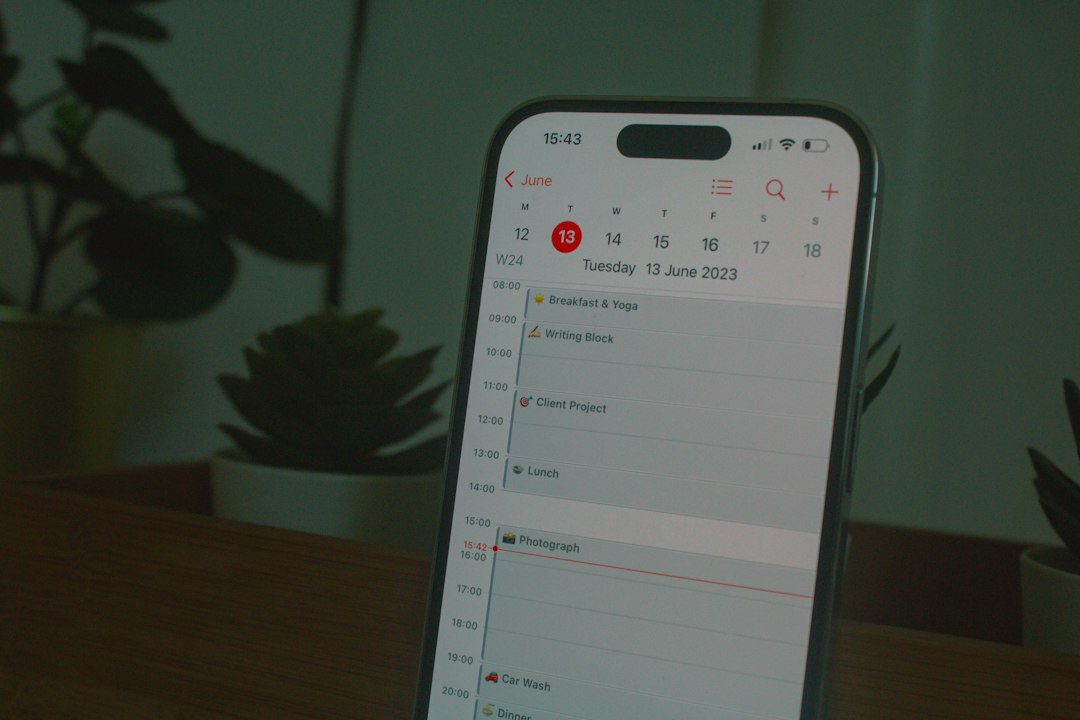
An AI social app can make a creator’s digital persona feel useful by helping fans remember a live session, a new video, or an agreed follow-up. That convenience creates an unexpected boundary: a conversational suggestion is not permission to place an event on someone’s private calendar. This implementation guide is for a mainstream AI social experience with text, voice, real-time digital human video and creator profiles. It proposes a reversible invitation workflow built on established calendar interoperability and privacy-risk principles. The examples describe proposed product behavior, not features asserted to exist in any particular app. A good reminder system must preserve user choice without losing the friendly tone of an AI persona.
A suggestion is not calendar authorization
Start with three visibly distinct steps: the AI persona proposes an event in chat, the user inspects a preview containing time and organizer, and the user explicitly chooses to add it to a calendar. Never infer permission from a conversation such as “that sounds fun.” A link that downloads an invitation should be labeled as such; it should not silently request broad calendar access. The application must disclose whether it is exporting a single invitation or requesting persistent read/write access to an account. Persistent authorization is more powerful and needs a separate justification. Make declining equivalent to remaining in the conversation, with no guilt-inducing messages. Record only the consent outcome necessary to prevent repeated prompts and investigate failed actions. The NIST Privacy Framework, published January 16, 2020, emphasizes identifying and managing privacy risk in terms of actual outcomes rather than assuming collection is harmless.
Represent time without inventing a local clock
A creator in Ho Chi Minh City might announce a session to a fan in Tokyo and another in London. Storing “seven tonight” as a string is insufficient because it has no stable interpretation. The iCalendar specification RFC 5545, published September 2009, distinguishes UTC times, date-times with named time-zone references and floating local times. Choose a single authoritative instant for an event and present a converted local preview; when the event is intentionally tied to a venue’s wall-clock time, preserve the intended time-zone identifier. Test daylight-saving transitions and destinations where the local date changes. Display the origin time zone and a human-readable equivalent before the user accepts. Avoid creating automatic recurring events from vague phrases like “see you every Friday” until frequency and end conditions are separately confirmed.
Define ownership, revisions and cancellation semantics
For each invitation, associate a stable event identifier with the creator announcement, not merely an editable title. When the organizer changes the start time, treat that as a revised event requiring understandable notice, not as an opportunity to create another duplicate reminder. Explain whether the change updates an event the user previously imported or provides a new file for manual acceptance. The user should also be able to remove the reminder or mute an event category without changing their AI persona relationship. Cancellation needs a visible state, because a deleted live session should not remain as an authoritative promise in a fan’s calendar. Design the system to handle a fan who has copied the invitation into another calendar provider; the app cannot guarantee remote deletion of exported copies. Explicitly distinguish revocation of future updates from deletion of already exported information.
Keep message content out of the calendar export
An invitation often travels through email, calendar sync, notifications and shared devices. This makes the event title and description a separate privacy surface. Prefer a neutral title such as “Creator live session” rather than pasting a user’s private conversation or a personal AI memory into the calendar file. Never include full chat transcripts, voice notes, contact lists or a fan’s private nickname in an invitation merely because those fields are available inside the AI social product. If a personalized link is necessary, use a short-lived token and explain how it expires; avoid adding an opaque identifier that becomes a cross-platform tracking key. The NIST Privacy Framework helps teams frame this as a data-minimization and risk-management issue. Use calendar-event visibility defaults cautiously because recipients may share family, work or school calendars.
Test the end-to-end flow with real user tasks
A product quality plan needs more than a successful API call. Recruit test participants with different device and calendar combinations and give them concrete tasks: inspect an invitation, decline without losing conversation context, accept with the correct time, change a reminder, and find the cancellation mechanism. Include a device set to a different time zone and one with daylight-saving rules. Measure time to complete, accidental authorizations, wrong-date interpretations, duplicate events and ability to reverse an action. The proposed acceptance threshold must be chosen before testing: for example, require zero wrong-time additions in the release test matrix, while publishing the sample size so readers do not confuse “zero observed” with mathematically proven safety. Provide a plain text alternative for users who do not connect any calendar.
Audit fan trust, not just reminder click-through
Success should not be defined as a higher calendar-import rate alone. A reminder that annoys users or appears unexpectedly on shared devices could generate more clicks and less trust. Measure completion of the intended live session independently from invitations created; keep withdrawal and complaint rates alongside successful saves. Record how often event corrections were acknowledged and how quickly cancelled sessions stopped generating notices. For product review, retain only a limited record of the consent event and relevant error diagnostics; define expiration and deletion mechanisms. A creator can still use an AI digital twin to answer questions, exchange messages or guide a fan to videos without any calendar integration. That fallback is part of the product’s value, not evidence of failed conversion. Treat added calendar convenience as a bounded service rather than an implied permanent relationship.
Editorial: Original design analysis for a mainstream AI Social App. Examples describe possible implementations, not confirmed Tuikor AI product features. Image: credited Unsplash photographer.
Sources
- IETF RFC 5545, Internet Calendaring and Scheduling Core Object Specification — September 2009
- NIST Privacy Framework Version 1.0 — January 16, 2020