On October 12, 2026, Character.AI, one of the most recognizable consumer AI startups of the generative-AI boom, filed for Chapter 11 bankruptcy protection. The company had attracted more than 200 million registered users and roughly 20 million monthly active users by 2024, according to Reuters’ October 14 analysis. It had world-class AI researchers, a compelling product and enormous consumer attention. Yet it still could not construct a durable business from the interactions it had popularized.
Why couldn’t millions of devoted users save Character.AI? The immediate answers include unsustainable computing expenses, limited subscription revenue, the loss of technical leadership and substantial legal and regulatory exposure. Those are documented contributors to the crisis. But I think its story also raises a larger industry question: what if generic, endlessly reproducible AI character chat is a transitional consumer product rather than the final form of AI companionship?
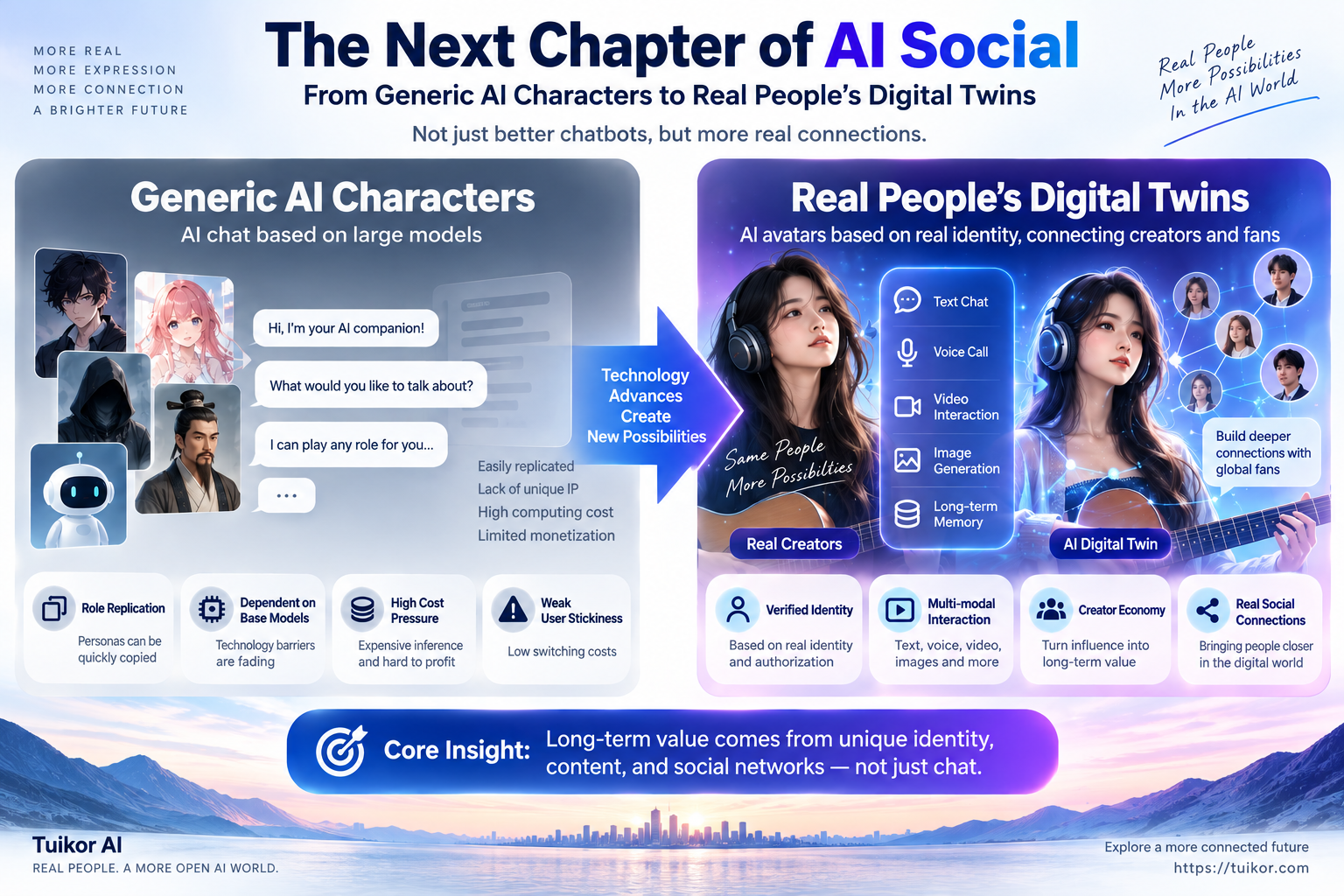
That second proposition is my strategic interpretation, not a fact established by bankruptcy proceedings or a verdict on every fictional character product. My argument is that the next durable wave of AI social experiences may center on real-person, consent-based digital twins: interactive identities linked to recognizable creators, legitimate rights, original content and existing human communities. It is a different source of value from simply asking a general-purpose model to impersonate another invented personality.
The point is not that artificial companionship has no future. Character.AI demonstrated precisely the opposite: humans are willing to invest time, emotion and attention in ongoing interactions with AI. The unresolved question is which business architectures can turn that demand into lasting, responsible value.
1. The economic paradox: the more users chatted, the harder the math became
According to Reuters’ reporting on the company and its bankruptcy materials, Character.AI’s monthly compute spending reached approximately $13.8 million in 2024. It reduced that figure to about $10 million a month in 2025, yet reported subscription revenue peaked at only about $2.8 million monthly and sometimes dropped below $1 million. Even after adding advertising, its monthly income reportedly never exceeded roughly $5.3 million. A separate Reuters report on the filing described losses exceeding $8 million per month.
The figures refer to different periods and categories, so it would be wrong to fabricate a precise single-month profit statement from them. What they show unmistakably is that the company struggled to earn enough from a huge user base to finance the intensive interaction that made the product engaging in the first place.
In a conventional social network, users create much of the conversational content themselves. Two people sending each other messages do not require the platform to produce every reply with a large language model. A character-companion service works differently: each AI-generated message consumes inference capacity. Longer discussions, memory processing, voice and multimodal features add costs. Some of the heaviest users may contribute the least positive margin when their payment remains fixed or nonexistent.
This creates a difficult commercial paradox. Product teams celebrate longer session durations, repeated conversations and stronger emotional attachment. Yet if the extra engagement does not generate sufficient incremental revenue, it can increase the deficit rather than improve unit economics. A consumer may happily talk to an AI character for hours but resist a subscription price high enough to pay for that usage.
Inference costs can fall, and companies can route requests among models, introduce usage tiers, limit free capacity and sell genuinely distinct experiences. Those are real options, not reasons to dismiss AI companionship. The more fundamental question is why a user would pay a meaningful premium to one character-chat platform when increasingly capable general AI assistants can also offer persona configuration, conversational continuity and voice interaction.
Usage validates interest; sustainable contribution margin validates a business. Character.AI’s bankruptcy illustrates how far apart those achievements can be.
2. The $2.7 billion Google deal: research strength did not become a lasting product moat
Character.AI was founded by researchers with exceptional credentials. Noam Shazeer contributed to the Transformer research that underpins modern language models, and co-founder Daniel De Freitas also came from Google. This background gave the startup a genuine technical advantage at the beginning of the consumer AI boom.
In August 2024, the company entered an agreement with Google that dramatically changed its trajectory. Alphabet’s September 2024 SEC filing says Google paid Character.AI $2.7 billion in cash, canceled certain convertible instruments, received a non-exclusive license to the company’s then-current large-language-model technology and hired some employees. The two founders and other researchers joined Google.
That $2.7 billion payment was not an acquisition price for the whole company. Similarly, Disney’s proposed $20 million deal during the 2026 bankruptcy proceedings involves a non-exclusive perpetual license to selected intellectual property and a separate court-supervised sale structure. Comparing the figures as if they represented two complete corporate valuations would be inaccurate.
The revealing change is organizational. Having lost key founders and talent, Character.AI increasingly depended on third-party foundation models while investing in entertainment, character experiences and interactive formats. That was not necessarily the wrong direction. Many great software companies buy their basic computing capabilities rather than inventing them. But an application using broadly accessible models needs to own something else that is difficult to copy.
For a digital social service, defensibility might come from authorized intellectual property, distinctive creators, original content rights, mature community norms, distribution, proprietary workflows or a network of relationships. Without a sufficiently strong application-level asset, even a product with an extraordinary head start can see its defining feature become something anyone else can offer.
3. My central thesis: generic AI character chat may be a transitional interface
Character.AI’s original breakthrough was to make simulated conversations with fictional characters and user-designed personalities accessible at consumer scale. People could create a supportive friend, a favorite archetype, an imaginary partner or an elaborate roleplay character. In the early years of generative AI, that felt genuinely novel. The specialist product offered an experience that most everyday software did not provide.
But the foundation models underneath the experience keep improving. General-purpose AI services increasingly support elaborate role instructions, multiple voices, long conversations, persistent preferences and visual interaction. If someone simply wants a friendly, humorous or knowledgeable fictional persona, the ability to create a similar experience in tools they already use makes installing and paying for a separate product less obviously necessary.
It would be unfair to suggest that Character.AI remained only a text-chat application. It added voice calls, visual creation, stories and other entertainment formats. More importantly, some users have genuine attachments to specific characters and communities. A long conversation history is not emotionally interchangeable with a few lines of prompt text. Those user experiences matter.
My narrower concern is the long-term economics of generic persona supply. If thousands of characters have no exclusive licensing, no developed fictional world and no relationship to distinctive external assets, many of their conversational properties can be reproduced at relatively low cost. The consumer may care about the experience, but the platform’s power to charge an enduring premium could weaken as the same underlying capability spreads.
When the defining feature of an application becomes a built-in feature of a model, the application needs another reason to exist. That does not make early character-chat products worthless. It means that demonstrating demand for AI conversation and owning the final social category are two different accomplishments.
There is, however, one important counterargument. A licensed anime or game character with a richly developed world and dedicated fans is a fundamentally different product from a quickly generated generic persona. Strong fictional IP can remain valuable for decades because the value is in the story, copyright, community and recognition—not merely in the model producing the dialogue. Authorized AI experiences built around major fictional franchises may become important long-term businesses. My thesis is about commoditized personas, not a blanket rejection of fiction or entertainment.
4. A different foundation: real identity, explicit consent and multi-dimensional digital twins
I believe another important trajectory begins not with a fictional role but with a real person. An actor, musician, creator, educator or ordinary user could authorize an AI digital twin informed by selected photographs, voice samples, knowledge, style and approved content. The resulting experience should always be identified as AI, not presented as though the person is personally speaking at that moment.
The phrase “one-to-one identity mapping” does not mean technology can perfectly reproduce a human mind. It means a digital representation can be linked to a specific real-world rights holder, with boundaries around what assets it may use, what it may say and when authorization can be changed or withdrawn.
That distinction matters economically. A foundation model can mimic a conversational tone, but cannot automatically acquire a singer’s legal likeness rights, exclusive creative catalog, genuine brand reputation or established audience relationships. Those assets exist outside the model. They do not become freely transferable just because language generation becomes cheaper.
Natural interaction also requires more than text. Tone of voice, facial movement, body language, timing, video, expressions, setting and a shared history all contribute to how we recognize another person. A digital twin built for real-time video, voice, personalized visual content and permissioned memory may deliver an experience that feels fundamentally different from reading replies generated by a generic character prompt.
Memory should not mean indefinite, hidden collection of personal conversations. A durable digital-persona service should let people understand what is remembered, correct outdated details and withdraw permissions. Otherwise the very feature marketed as emotional continuity becomes a source of privacy and trust risk.
Two routes to long-term AI social value
| Generic AI persona | Creator-authorized digital twin |
|---|---|
| Personality often defined by reproducible prompts | Identity anchored to a consenting rights holder |
| Value concentrated in simulated conversation | Value also tied to real IP, voice, content and fans |
| Relationship typically begins with an invented role | May extend an existing creator–fan relationship |
| Defensibility depends on proprietary character content and execution | Potential defensibility through authorized identity and networks |
These are hypotheses about sustainable differentiation, not promises that real-person digital twins automatically generate profitable businesses. Photorealism and live video introduce their own serving costs, consent challenges and safety obligations. The advantage has to be earned through actual creator participation and user behavior.
5. From a fictional chatbot to a creator–fan business network
Consider a hypothetical musician with 500,000 followers. Today she can publish short videos, release songs and host livestreams. But she cannot hold individual conversations with every fan across every time zone. A legally authorized AI twin could offer a new layer of interaction around her approved voice, content, public knowledge and style, clearly disclosed as a digital representation rather than live access to the performer.
That changes the starting point of customer acquisition. The fan does not discover a random personality and decide whether the chat seems entertaining. The fan already knows the creator, follows her work and may have a reason to seek more of the experience. The digital twin can potentially extend an existing relationship rather than inventing one from nothing.
It changes monetization as well. A subscription for interchangeable text replies competes directly with the capabilities and prices of general models. A subscription for authorized creator-specific interactions, exclusive content or membership privileges has a different proposition: the user is paying for access to something attached to a real, distinct IP. Whether that proposition converts into meaningful revenue must be measured, not assumed.
It can also change network effects. A platform that gradually brings together authentic creator identities, rights-cleared content, audiences and distribution relationships may accumulate assets that do not arise automatically from adding more GPUs or calling a better API. The network is not just AI talking to users. It is real people, creators and fans connected through a new interactive medium.
None of this eliminates the need for moderation, user trust, good unit economics or realistic retention analysis. Creator channels are not free distribution forever, and fans will not pay simply because a recognizable face is animated. But it offers a potential commercial moat beyond generic conversation.
6. Why Tuikor AI is pursuing digital-human social interaction
This is the product direction we are exploring at Tuikor AI. Rather than defining an AI identity solely through a written persona prompt, the platform brings together photo-and-voice-based digital-twin creation, personality customization, multimodal communication, real-time digital-human video interaction and ongoing memory. These are described in the product’s official materials; their implementation and availability may vary by product version and market.
For a creator, the opportunity is to turn an already recognizable identity into an interactive, evolving digital presence. Fans can engage with approved digital content and an AI representation through more than typed messages. From a business standpoint, the distinctive asset is not simply the animated face or a particular underlying model. It is the creator’s legitimate participation, approved content, recognizable identity, audience and continuing relationship with that audience.
There is an important responsibility attached to that model. The user must know when they are interacting with an AI twin. The creator needs enforceable authorization boundaries. Personal photographs and voice recordings must be handled appropriately, and consent should be revisitable. Long-term memory should be controllable, not a hidden accumulation of intimate details. Strong identity checks, reporting and revocation workflows remain essential areas of continuing development for this category.
My belief is simple: models can reproduce many forms of personality simulation, but they cannot automatically reproduce legitimate access to an individual’s creative work, likeness or social trust. Those relationships could become the lasting foundation of a new kind of AI social network. That is a strategic direction to test in the market, not a claim that every hard engineering or compliance issue has been solved.
7. Bankruptcy is not the end of AI companionship—but it changes the industry’s questions
Character.AI’s crisis cannot be blamed exclusively on the kind of personas it offered. Legal and regulatory problems were significant. On October 14, New York Attorney General Letitia James and a coalition of 39 other attorneys general urged the bankruptcy court to protect consumers’ sensitive information, particularly that of minors. Their filing details alleged safety failures and findings from investigations. Such allegations and investigations should not be conflated with final judgments in every individual case.
The emotional impact of AI companionship also deserves more scrutiny. An August 2026 study published in Nature Human Behaviour examined Character.AI users and found that relationships between companionship-oriented use, offline social networks and psychological well-being varied with the way people used the service. These observational findings do not prove that every AI companion harms its users or that chatbot use caused the measured outcomes. They do challenge a simplistic idea that more time spent chatting is always a better product outcome.
For founders, Character.AI leaves a demanding checklist. Does the product produce a positive contribution after compute and safety costs? Does it have assets beyond capabilities shared by every foundation-model provider? Does the user understand whether they are speaking to a fictional AI, an AI representation of a real person, or the person directly? Can creators manage permission and rights? Does the experience help people exercise agency and maintain connections outside the application?
I do not see the bankruptcy as proof that people will stop wanting AI companionship. Instead, it may mark a transition from the first generation of roleplay-heavy consumer interfaces toward more differentiated forms of digital identity, content and social connection. Licensed fictional worlds can thrive; general AI assistants will keep improving; creator-authorized digital twins may open another important lane.
Character.AI helped open the door to AI companionship. But the product that opens a market is not necessarily the product that defines its final form.
The most promising next generation of AI social products may not be measured by how many easily imitated fictional people they generate. It may be measured by how many real people gain new ways to express themselves, reach others and build meaningful, consent-based relationships through their digital identities.
Sources, filings and research
Character.AI — official Chapter 11 update (October 12, 2026); Reuters — The rise and fall of an AI chatbot darling (October 14, 2026); Reuters — Bankruptcy filing and Disney proposal (October 13, 2026); Alphabet — September 2024 SEC filing; New York Attorney General — Consumer protections in Character.AI bankruptcy (October 14, 2026); Nature Human Behaviour — AI companionship and psychological well-being (August 4, 2026); Tuikor AI — official product website.
Editor’s note: Financial, transaction, legal and research claims are attributed to the public sources above. The argument that generic persona chat may be transitional and creator-authorized digital twins may offer greater defensibility is the author’s independent industry analysis—not an established finding about the cause of bankruptcy.
中文版深度分析:Character.AI为什么破产?2亿注册用户也没能救活“过渡时代”的AI社交。